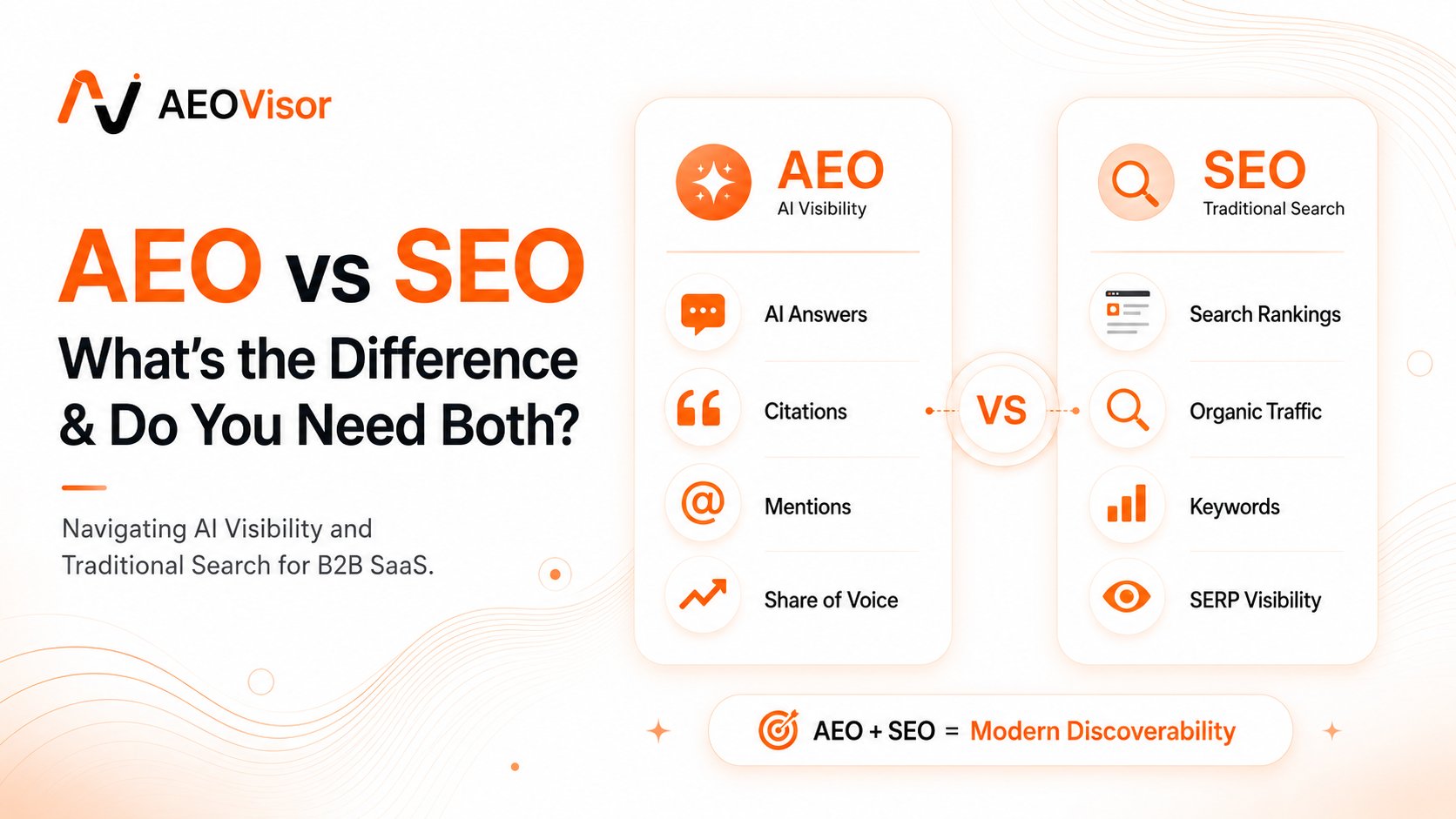
Understanding the distinction between answer engine optimization (AEO) and search engine optimization (SEO) is critical for B2B SaaS brands, agencies, and growth teams navigating the evolving digital landscape. While SEO focuses on improving visibility in traditional search results, AEO aims for your brand to be cited, mentioned, and recommended in AI-generated answers from platforms like ChatGPT, Gemini, Perplexity, and Claude, enhancing your overall AI visibility. This matters now because B2B buyers increasingly turn to AI assistants for initial research, influencing their vendor shortlists before they ever open Google. In this guide, we clarify the core differences between AEO vs SEO, highlight their symbiotic relationship in driving AI search optimization and generative engine optimization, and provide practical strategies to excel in both.
Short answer: Answer engine optimization (AEO) focuses on getting your brand cited or mentioned in AI-generated answers and enhancing your AI visibility, while search engine optimization (SEO) aims to improve your website's visibility and ranking in traditional search engine results pages. Both are essential for comprehensive digital discoverability in today's AI-driven world, influencing AI citations and overall brand visibility in ChatGPT and other AI platforms, forming a crucial part of any AI marketing strategy.
What is Search Engine Optimization (SEO)?
Search engine optimization (SEO) is a long-standing digital marketing discipline focused on improving a website's visibility in unpaid, or "organic," search results. For B2B SaaS teams, this means optimizing your website and content to rank highly for keywords relevant to your product or service on platforms like Google. The goal of B2B SaaS SEO is to drive qualified traffic to your website by appearing prominently in the search engine results pages (SERPs).
Traditional SEO involves a multifaceted approach, including technical SEO (site speed, mobile-friendliness, crawlability), on-page SEO (keyword optimization, content quality, meta descriptions), and off-page SEO (backlink building, brand mentions). The better your search engine optimization, the more likely potential customers are to discover your solutions when they actively search for them. This foundational work remains incredibly important, as a well-optimized website serves as the primary source of truth for both human users and, increasingly, AI models, impacting overall AI visibility.
For B2B SaaS, robust SEO ensures that your product pages, solution guides, and thought leadership content are discoverable by decision-makers and influencers. It builds authority and trust, which are critical components for any online presence. Without strong SEO, your valuable content might remain hidden, regardless of its quality, making it harder to attract and convert your target audience.
What is Answer Engine Optimization (AEO)?
Answer engine optimization (AEO), also known as generative engine optimization or AI search optimization, is the practice of optimizing your brand's content to be featured in AI-generated answers. This goes beyond simply ranking in search results, aiming for your brand, products, or services to be directly cited, mentioned, or recommended when users pose questions to AI models like ChatGPT, Gemini, Perplexity, and Claude. The objective is to achieve high AI visibility and a strong AI share of voice within these conversational interfaces, a key component of any effective AI marketing strategy.
AEO responds to a fundamental shift in how people access information. Instead of sifting through ten blue links, users are now asking AI assistants direct questions and receiving synthesized answers. For B2B SaaS, this means your brand could be introduced to a prospect much earlier in their buying journey, sometimes before they even visit a traditional search engine. Optimizing for AEO involves structuring content for clarity, factuality, and direct answers, making it easy for AI models to extract and present your information accurately, thus improving AI search optimization.
Achieving strong AEO means focusing on how AI models process, understand, and summarize information. This includes ensuring factual accuracy, using clear and concise language, and providing definitive answers to common questions within your niche. Ultimately, the goal is to drive AI citations, where AI engines explicitly reference your brand or website as a source of information, significantly boosting your brand visibility in ChatGPT and other AI platforms.
AEO vs. SEO: A Strategic Comparison
While both SEO and AEO aim to improve discoverability, their methodologies, objectives, and measurement strategies differ significantly. Understanding these distinctions is crucial for developing a comprehensive AI marketing strategy that encompasses both answer engine optimization and search engine optimization.
Key Differences in Focus and Methodology
- SEO Focus: Primarily concerned with improving website rankings in traditional search engine results pages (SERPs). The methodology involves keyword research, technical optimization, content creation, and link building to satisfy search engine algorithms, supporting overall search engine optimization efforts.
- AEO Focus: Centered on ensuring your brand, products, or services are cited, mentioned, or recommended in AI-generated answers. This requires optimizing content for AI consumption, focusing on clarity, conciseness, and direct answers to common user queries, driving AI citations and a strong AI share of voice. It also involves understanding how AI models attribute information and generate summaries for effective generative engine optimization and AI search optimization.
Comparison Matrix: AEO vs. SEO
| Feature | Search Engine Optimization (SEO) | Answer Engine Optimization (AEO) |
|---|---|---|
| Primary Goal | Rank high in SERPs, drive organic website traffic | Be cited/mentioned/recommended in AI answers, increase AI share of voice |
| Target Platform | Google, Bing, traditional search engines | ChatGPT, Gemini, Perplexity, Claude, AI-powered search experiences |
| Key Metrics | Organic rankings, website traffic, conversions, keyword positions | AI share of voice, AI citations, mention frequency, prompt coverage |
| Content Strategy | Comprehensive articles, blog posts, landing pages, keyword-rich content | Concise, factual answers, structured data, FAQs, clear definitions |
| Optimization Tactics | Technical SEO, on-page SEO, off-page SEO, link building | Content clarity, factual accuracy, LLM-friendly structuring (e.g., llms.txt), prompt engineering understanding |
| Measurement | Google Analytics, Search Console, SEO tools | AEO trackers, AI visibility platforms (e.g., AEOVisor), manual prompt testing |
| Time to Impact | Medium to long-term (months to years) | Potentially faster for direct answers, but consistent visibility is long-term |
While SEO is about being found when someone searches, AEO is about being recommended when someone asks. Both require high-quality content, but AEO demands an additional layer of optimization for AI comprehension and synthesis to achieve optimal AI visibility.
The Symbiotic Relationship: Why You Need Both
The rise of AI-powered search doesn't diminish the importance of search engine optimization (SEO), but rather expands its scope. For B2B SaaS brands and agencies, excelling in both answer engine optimization (AEO) and SEO is no longer optional, it’s a strategic imperative. Your authoritative, high-quality web content, optimized for traditional search, becomes the foundational fuel for your AI visibility and overall AI search optimization.
Think of SEO as building the robust engine and fuel tank for your digital presence. It ensures your website is discoverable, credible, and provides comprehensive information. AEO then becomes the advanced navigation system, directing AI models to accurately and favorably represent your brand in their answers. Without strong SEO, your content might not even be accessible or considered authoritative enough by AI models to be cited. Conversely, without AEO, even top-ranking content might be overlooked by AI in favor of more readily digestible information from competitors, impacting brand visibility in ChatGPT.
By understanding the nuances of how AI engines consume and present information, you can proactively shape your brand's narrative across all crucial discovery surfaces. This integrated approach, combining the strengths of B2B SaaS SEO with dedicated AEO efforts, ensures your brand achieves maximum discoverability and influence, driving effective generative engine optimization.
Measuring Success in the AI-First Era
Measuring the effectiveness of your AEO efforts requires a new set of metrics and tools. Traditional SEO metrics, while still relevant, don't fully capture your brand's performance in AI-generated answers. At AEOVisor, we focus on key indicators that directly reflect your AI visibility and influence, helping you track your brand visibility in ChatGPT and other platforms.
Key AEO Metrics for B2B SaaS Teams
| Metric | What it measures | Why it matters |
|---|---|---|
| AI Share of Voice | The percentage of AI-generated answers in your category that mention or recommend your brand compared to competitors. | Directly reflects your brand's prominence and influence in AI conversations. A higher share means more AI-driven recommendations. |
| AI Citations | The frequency and quality of direct references or links to your website/brand within AI answers. | Indicates that AI engines trust your content as a primary source, driving direct traffic and building authority. |
| Mention Frequency | How often your brand is mentioned, even without a direct citation, for relevant queries. | Shows AI models are aware of your brand and considering it in their summaries, influencing brand recall. |
| Competitor Presence | Tracking which competitors are mentioned or cited by AI for your target keywords. | Helps identify gaps in your AEO strategy and understand competitor strengths in the AI landscape. |
| Prompt Coverage | The range of prompts and questions for which your brand appears in AI answers. | Ensures your AEO efforts are broad enough to cover the diverse ways users might ask about your solutions. |
| Fix Priority Score | A score indicating the impact of specific technical or content fixes on your AI visibility. | Prioritizes actionable steps, ensuring your team focuses on changes that yield the greatest AEO improvements. |
Without these specific metrics, it's impossible to truly understand your brand's performance in the AI ecosystem. We designed our platform to give you clear, actionable insights into these critical areas, moving beyond guesswork to data-driven decisions for your AI marketing strategy.
Implementing Your AI Marketing Strategy: The AEOVisor Visibility Loop
For B2B SaaS teams and agencies, implementing an effective AI marketing strategy requires a structured approach. At AEOVisor, we've developed a comprehensive workflow, the AEO Visibility Loop, to guide you from initial assessment to continuous improvement, ensuring your brand achieves and maintains strong AI visibility through effective answer engine optimization.
- Audit: We begin by crawling your site to understand how AI models perceive your content. Our platform generates an llms.txt file and provides a 0-100 AI readiness score, complete with prioritized fixes. You can run a free AEO Audit Tool.
The distinction between AEO vs SEO is no longer a theoretical debate, but a practical consideration for every B2B SaaS brand and agency. While search engine optimization (SEO) remains the bedrock of online discoverability, answer engine optimization (AEO) is the imperative for shaping your brand's narrative in the age of AI, driving critical AI visibility and AI share of voice. By integrating both disciplines into a cohesive AI marketing strategy, you ensure your brand is not just found, but actively recommended across all critical discovery surfaces, boosting your brand visibility in ChatGPT and other AI platforms through strong AI citations. Don't let your competitors define your brand in the age of AI.
Compare your brand's AI visibility against competitors by running a free AI visibility audit for your brand and start taking control of your AI narrative today.