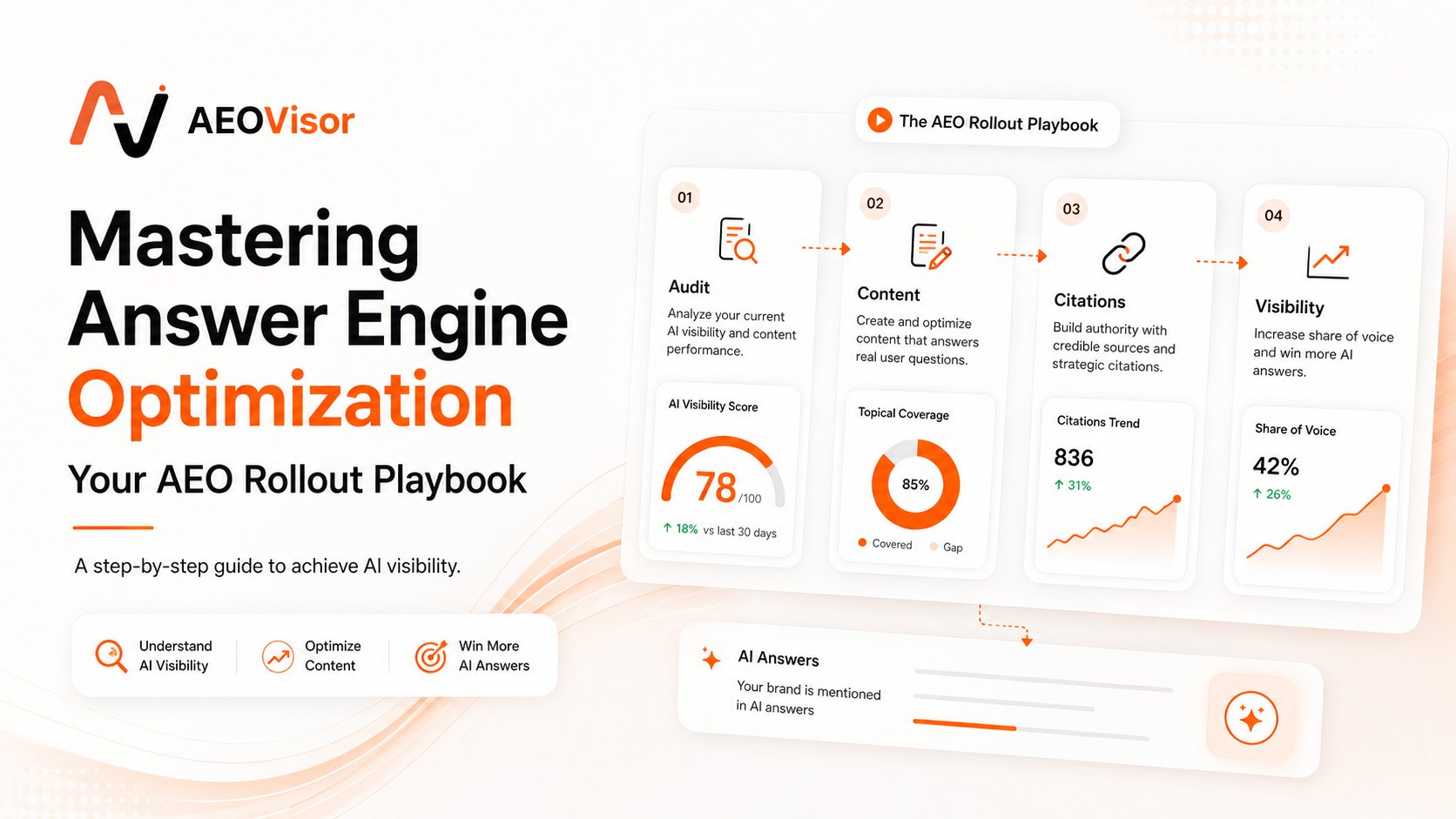
Mastering Answer Engine Optimization: Your AEO Rollout Playbook

Your step-by-step guide to getting cited by AI and winning Share of Voice in ChatGPT, Gemini, and Perplexity.

Implementation Guide·11 min read
Mastering Answer Engine Optimization: Your AEO Rollout Playbook

The digital landscape is shifting. Users no longer just want links; they want immediate, direct answers to their questions. AI-powered search engines, chatbots, and voice assistants are rapidly becoming the primary interface for information discovery. If your brand isn't optimized to be the definitive answer in these new experiences, you risk becoming invisible to a growing segment of your audience.

Answer Engine Optimization (AEO) is the strategic practice of structuring and enhancing your content so that AI systems can confidently use it as a direct answer to a user’s question. It's about being selected, cited, and trusted by AI, not just ranked by traditional search engines. At AEOVisor, we provide the platform and the playbook to help you navigate this evolution, ensuring your brand's voice is heard even in zero-click search environments. To learn more about how our platform boosts your brand's AI visibility and AEO performance, explore our blog.

Understanding Answer Engine Optimization (AEO)

Answer Engine Optimization (AEO) focuses on making your content useful, clear, and machine-readable, positioning it as the ultimate source of truth for AI. This means optimizing for how AI understands, extracts, and synthesizes information, rather than solely for keywords or backlinks, which is crucial for effective AI content optimization.

AEO vs. SEO: A Crucial Distinction

While both aim for online visibility, their primary objectives differ significantly:

  • Traditional SEO: Primarily focuses on ranking web pages high in organic search results to drive clicks and traffic to your website. Success is measured by rankings, organic traffic, and click-through rates.
  • AEO: Prioritizes providing direct answers to user queries within the AI interface itself. Success is measured by AI citations, brand mentions, Share of Voice, and referral traffic from AI platforms, demonstrating strong AI visibility.

A strong SEO foundation is often a prerequisite for effective Answer Engine Optimization, but AEO necessitates a shift in content creation and optimization. It's an extension of SEO, not a replacement for your overall AI content strategy.

Why AEO Matters Now More Than Ever

Answer Engine Optimization is not a future trend; it's an active, measurable channel already driving significant impact, especially with the rise of AI search:

  • Accelerating AI Search Adoption: AI referral traffic is growing rapidly, doubling approximately every quarter. This highlights the importance of an effective AEO strategy.
  • Zero-Click Search is the New Normal: Features like Google AI Overviews and AI Mode mean users increasingly get answers directly on the SERP without clicking through. If your content isn't cited in this zero-click search environment, you're invisible.
  • Higher-Value AI Visitors: Studies show that AI-driven visitors often convert at significantly higher rates and spend more time on site, indicating higher intent, making AI content optimization highly valuable.
  • Brand Visibility and Trust: Being cited by AI builds brand recognition and establishes your authority, positioning you as an expert in your field and boosting your overall AI visibility.
  • First-Mover Opportunity: There's a significant gap between organizations recognizing AEO's importance and actively implementing it, offering a clear advantage for early adopters in the field of Answer Engine Optimization.

How AI Answer Engines Work: The RAG Process

AI answer engines use a process called Retrieval-Augmented Generation (RAG process) to find, evaluate, and synthesize content from across the web. Understanding this pipeline is essential for optimizing your content for Answer Engine Optimization.

Key Stages of AI Answer Generation:

  1. Query Interpretation: The AI engine parses the user's intent, converting it into a semantic representation, identifying underlying concepts and entities.
  2. Retrieval: The system searches its index for documents semantically relevant to the query, pulling candidate pages based on conceptual similarity, a key step in effective AI content optimization.
  3. Ranking and Selection: Retrieved documents are scored on relevance, authority, recency, and structural quality. While top-ranking Google pages are often cited, AI engines are increasingly diversifying their sources for better AI visibility.
  4. Answer Generation: The AI synthesizes a coherent response by extracting key facts, statistics, and explanations, then rewrites them in natural language.
  5. Citation: The engine attributes specific claims to their source documents. Content that provides clear, citable facts with supporting data is more likely to be cited, a core goal of Answer Engine Optimization.

Key factors AI engines prioritize when selecting sources include clear, direct answers, specific statistics and data points, logical structure with headings, strong authority signals (E-E-A-T, backlinks, domain reputation), content freshness, and structured data like schema markup, all contributing to successful AEO strategy.

Your AEO Rollout Playbook: Step-by-Step Implementation

Implementing a successful Answer Engine Optimization strategy requires a systematic approach across content structure, citation quality, schema markup, entity recognition, and topical authority. This comprehensive AEO strategy ensures optimal AI visibility.

Step 1: Conduct an AI Readiness Audit

Before you optimize, you need to know where you stand. We recommend starting with an AI readiness audit at aeovisor.com. Our platform instantly scans your site for AI crawlability, structured data, and llms.txt quality, giving you a 0-100 score with prioritized fixes, essential for a robust AI content strategy.

This audit will also generate a structured llms.txt file and simulate how AI crawlers read your site, helping you identify missing schema, broken links, and unoptimized content pages, all vital for effective Answer Engine Optimization.

Step 2: Craft Answer-First Content

AI engines prioritize content that gets straight to the point. Lead every section with a direct answer, a fundamental aspect of successful AI content optimization.

  • Start each H2 or H3 section with a 40-60 word direct answer to the question implied by the heading.
  • Place your primary keyword within the first 100 words of the article.
  • Use the inverted pyramid structure: most important information first, supporting details after.
  • Write definitions in a format AI can easily extract, such as: "[Term] is [clear definition]." This helps with Answer Engine Optimization.

Step 3: Structure Content for AI Parsing

AI engines parse content by sections, not entire pages. Each section must be a self-contained unit that can be understood and cited independently, crucial for effective AI content optimization and achieving high AI visibility.

  • Use descriptive H2 and H3 headings; questions work particularly well.
  • Keep sections concise, ideally 200-400 words, with clear semantic boundaries.
  • Utilize bullet points and numbered lists for processes, features, or summaries.
  • Add comparison tables for side-by-side evaluations.
  • Include a table of contents for improved navigation signals, aiding in Answer Engine Optimization.

Step 4: Integrate Authoritative Citations

AI engines trust content that cites its own sources, bolstering the credibility of their generated responses and enhancing your AI visibility in AI search results.

  • Include a specific statistic or data point every 150-200 words.
  • Link directly to the original, authoritative source (e.g., .gov, .edu, peer-reviewed research, major industry reports).
  • Use specific numbers, percentages, and figures rather than vague phrases.
  • Attribute claims clearly by naming the organization, study, or dataset, a key aspect of strong Answer Engine Optimization.

Step 5: Implement Strategic Schema Markup

Schema markup provides machine-readable context, which is critical for AI engines to understand your content type, structure, and key claims, significantly boosting your structured data capabilities for Answer Engine Optimization.

  • Article schema (BlogPosting): Essential for blog posts, providing AI engines with author, publication date, and topic information.
  • FAQPage schema: Highly impactful for Q&A sections, directly enabling AI engines to extract question-answer pairs, improving your AI visibility.
  • BreadcrumbList schema: Helps AI understand your content's position within your site hierarchy, providing topical context.

Always validate your schema using tools like Google's Rich Results Test before publishing to ensure accuracy and avoid errors that could reduce AI trust signals, which is vital for a robust AEO strategy.

Step 6: Optimize for Entity Recognition

AI engines identify entities (people, organizations, products, concepts) and their relationships. Optimizing for entity recognition means helping AI understand your content at a conceptual level, a crucial part of effective AI content optimization.

  • Define key terms clearly when first introduced.
  • Use consistent terminology throughout your content; avoid unpredictable synonyms.
  • Link to authoritative external sources (like Wikipedia or industry standards) that define the same entities.
  • Reference your brand by its official name consistently.
  • Mention related entities to establish semantic context (e.g., referencing ChatGPT, Gemini, and Perplexity when discussing AI search), essential for comprehensive Answer Engine Optimization.

Step 7: Build and Maintain Topical Authority

AI engines favor sources that demonstrate deep, consistent expertise on a topic. A single optimized article won't outperform a site with a complete topic cluster, making a strong AEO strategy vital for long-term AI visibility.

  • Create pillar content surrounded by supporting cluster articles.
  • Interlink related articles with descriptive anchor text.
  • Publish consistently on your core topics and update existing content regularly, as AI engines prefer content that is fresher, enhancing your Answer Engine Optimization efforts.
  • Cover subtopics comprehensively, addressing areas your competitors might miss.

Step 8: Enhance User Experience and Site Performance

Even though Answer Engine Optimization focuses on answers, user experience and site performance still matter. Pages that load quickly, read clearly, and work well on mobile send clear signals of quality that support AI answer selection in AI search environments.

  • Ensure your website is fully responsive and optimized for mobile devices.
  • Optimize your website's loading speed; faster sites are preferred by both users and search engines.
  • Use clear fonts, appropriate line spacing, and break up large blocks of text to enhance readability.
  • Design your website to be accessible to all users, further supporting your AI content optimization goals.

Step 9: Optimize for Voice Search and Featured Snippets

Voice search and featured snippets are direct precursors to AI-generated answers. Optimizing for them significantly improves your Answer Engine Optimization and overall AI visibility in AI search.

  • Write content using natural, spoken language patterns that mirror how people ask questions verbally.
  • Focus on longer, more specific, question-based keywords common in voice searches.
  • For featured snippets, provide a concise, definitive answer to a question in the first paragraph or section of your content, often followed by more detailed information. Use the exact question or a close variation as an H2 or H3 heading, a key facet of effective AI content optimization.

Measuring AEO Success: Beyond Traditional Metrics

Measuring Answer Engine Optimization success requires looking beyond traditional organic traffic metrics. It focuses on visibility, direct answer provision, and building brand authority, particularly in the realm of AI visibility and Share of Voice.

Key AEO Metrics to Track:

  • AI Citation Count: How often your content is cited by platforms like ChatGPT, Gemini, Perplexity, and Claude.
  • Share of Voice: Your brand's citation frequency relative to competitors for your target topics.
  • AI Referral Traffic: Visits to your site originating from AI platforms, trackable in Google Analytics.
  • Brand Mention Volume: How frequently AI engines mention your brand when answering relevant queries.
  • Appearance Rate: The percentage of relevant queries where your brand appears in AI responses.

How We Track Your Progress at AEOVisor:

At AEOVisor, we provide dedicated tools to track your Answer Engine Optimization performance and translate insights into action:

  • Our AEO Tracker runs real buyer-intent prompts and measures how often your brand is mentioned versus competitors across 4 AI engines, giving you weighted Share of Voice scores, prompt win rates, and trend charts, crucial for understanding your AI visibility.
  • With Citation Intelligence, you see exactly which sources AI engines cite when recommending your category, helping you understand what drives AI recommendations for your AI content strategy.
  • The Action Center then translates these insights into prioritized fix lists, ranked by impact, so you know what to do next to improve your Answer Engine Optimization.
  • We also offer Brand Monitor alerts for changes in AI mentions and white-label PDF reports for clients and stakeholders. To understand how AEOVisor can further boost your brand's AI visibility & AEO performance, check out our detailed platform overview.

Common AEO Mistakes and How to Avoid Them

Steer clear of these common pitfalls to accelerate your Answer Engine Optimization results and ensure your efforts are effective in your overall AEO strategy:

  • Treating AEO as Separate from SEO: Answer Engine Optimization is an extension, not a replacement. Strong SEO fundamentals (technical health, quality content, backlinks) directly support AEO performance.
  • Keyword Stuffing Instead of Entity Optimization: AI engines use semantic understanding, not keyword density. Focus on comprehensive topic coverage and clear, consistent entity definitions for better AI content optimization.
  • Ignoring Structured Data: Many teams skip schema markup, which is a missed opportunity. FAQPage schema, in particular, can significantly increase your content's visibility in AI-generated responses and improve your AI visibility.
  • Publishing Without Authoritative Citations: Unsupported claims rarely get cited by AI engines. Always back your data and statistics with credible, linked sources, a cornerstone of effective Answer Engine Optimization.
  • Neglecting Content Freshness: AI engines weight recency heavily. Publishing once and forgetting about it is an AEO failure mode. Update your high-value content quarterly with new data and examples, crucial for maintaining AI visibility.
  • Optimizing for One AI Platform Only: Focusing exclusively on ChatGPT ignores the significant presence of Google AI Overviews, the rapidly growing Perplexity user base, and other engines like Gemini and Claude. Optimize broadly for maximum AI visibility in AI search.

Answer Engine Optimization is no longer a "nice-to-have" experiment; it is a strategic necessity for any brand seeking to remain visible and authoritative in the evolving digital ecosystem. By embracing an AEO mindset, structuring your content for AI retrieval, building undeniable authority, and continuously monitoring your performance, you can ensure your brand is consistently cited as the source of truth, boosting your overall AI visibility and Share of Voice.

The window to build an AEO advantage is open now. Ready to start winning in AI search? Run a free AI readiness audit at aeovisor.com and see your brand's AI Visibility Score today. Stop guessing, start measuring, and dominate your category in the age of AI.

Tags:Answer Engine OptimizationAEOAI searchAI content optimizationAEO strategyAI visibilityRAG processChatGPTGeminiPerplexitystructured dataShare of Voicezero-click search

Ready to improve your AI visibility?

Track how AI recommends your brand

Audit your AI readiness, monitor Share of Voice across ChatGPT, Gemini, and Perplexity — free to start.

Get started free
Back to blogAEOVisor · April 3, 2026
Mastering Answer Engine Optimization: Your AEO Rollout Playbook — AEOVisor Blog