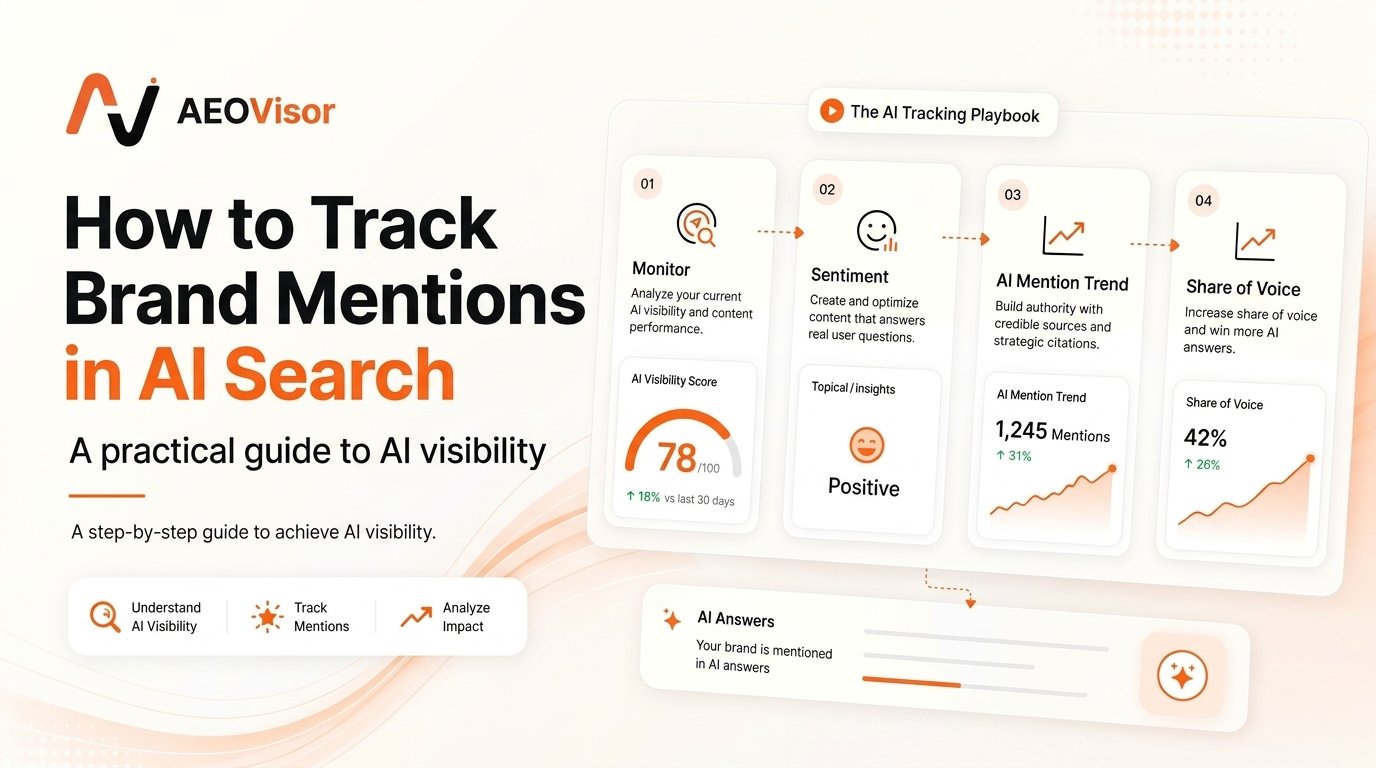
Yes, you can track brand mentions in AI search, and here is the short version: you monitor how often ChatGPT, Gemini, Perplexity, Claude, and other answer engines name your brand in their responses, then you measure that presence with metrics like Share of Voice and an AI Visibility Score. You do this by running a set of buyer prompts through each engine on a regular schedule and analyzing the answers. A dedicated AI brand monitoring tool automates the whole process so you always know where you stand.
Let's walk through exactly how it works, which numbers to watch, and how to turn the data into wins. I'll show you exactly how to track AI visibility with Aeovisor, from setting up prompts to analyzing results to finding optimization opportunities.
Why Tracking AI Brand Mentions Is Different From Traditional Brand Monitoring
Tracking brand mentions in AI search is different because there is no stable ranked list to check. Traditional brand monitoring scans websites, news, and social feeds for your name. AI brand monitoring watches what a model actually says when someone asks a question, and that answer can change from day to day.
Here is why the old playbook falls short. Classic tools like Google Alerts or social listening platforms look for published mentions on the open web. AI answers are generated fresh for each prompt, so the same question can produce a different response tomorrow. Two things make this tricky, and both matter for your team.
First, AI answers drift. What ChatGPT says about your brand this week can shift next week as models update and competitors publish new content. A one-time check tells you where you stood, not where you stand now.
Second, engines disagree. Your brand can dominate ChatGPT's answers and be completely invisible in Perplexity, because each engine pulls from different sources. Tracking only one platform gives you false confidence. That is why cross-engine coverage is the whole game.
There is one more wrinkle worth knowing: a mention and a citation are not the same thing. A mention means the AI named your brand in its answer. A citation means the AI used a specific page as a source. You want to track both, and we will cover each below.
The Metrics That Actually Matter for AI Brand Visibility
The core metrics for AI brand visibility are Share of Voice, AI Visibility Score, citation share, mention frequency, average position, and sentiment. Together they tell you how often you show up, how you stack up against rivals, and whether the AI describes you in a flattering way. Skip the vanity numbers and anchor on these six.
Here is what each one measures and why it earns a spot on your dashboard.
Share of Voice
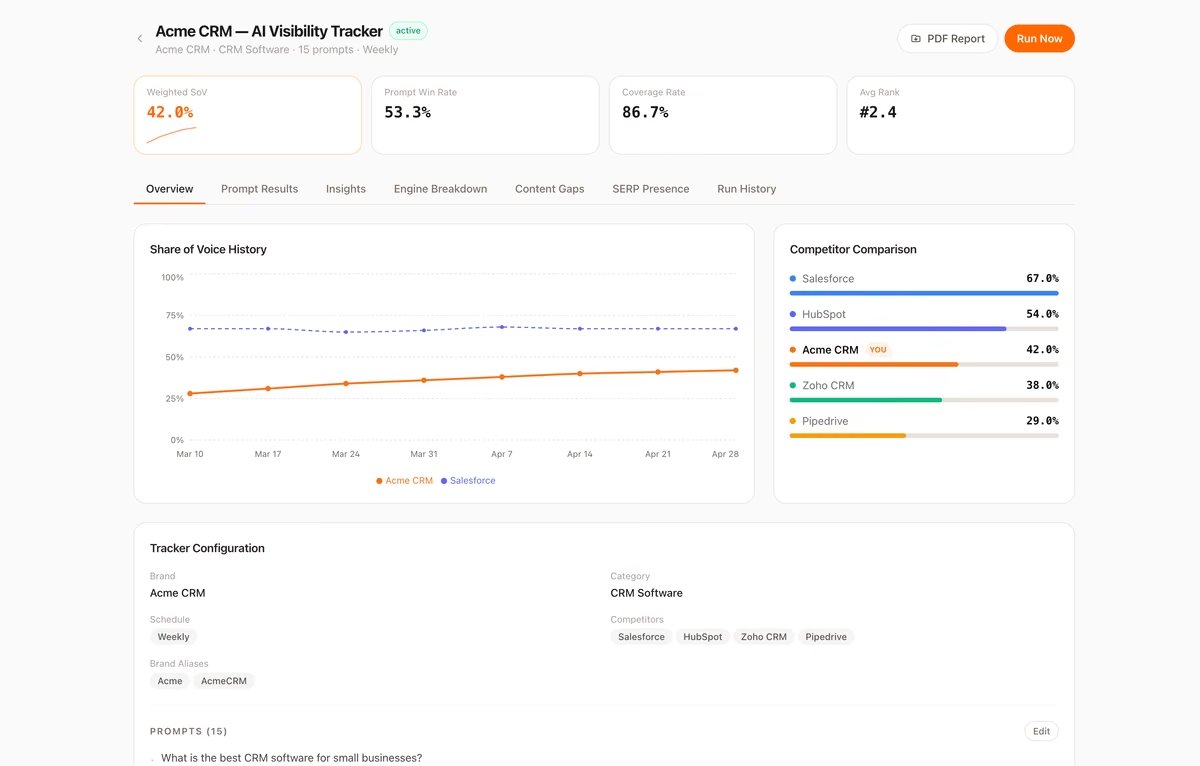
Share of Voice is the percentage of relevant AI answers that mention your brand compared to your competitors. It is the single best benchmark for competitive standing. If a buyer asks "what's the best analytics tool for SaaS?" and your brand appears in 3 of 10 answers while a rival appears in 7, your Share of Voice is lower, and you know exactly who to chase.
AI Visibility Score
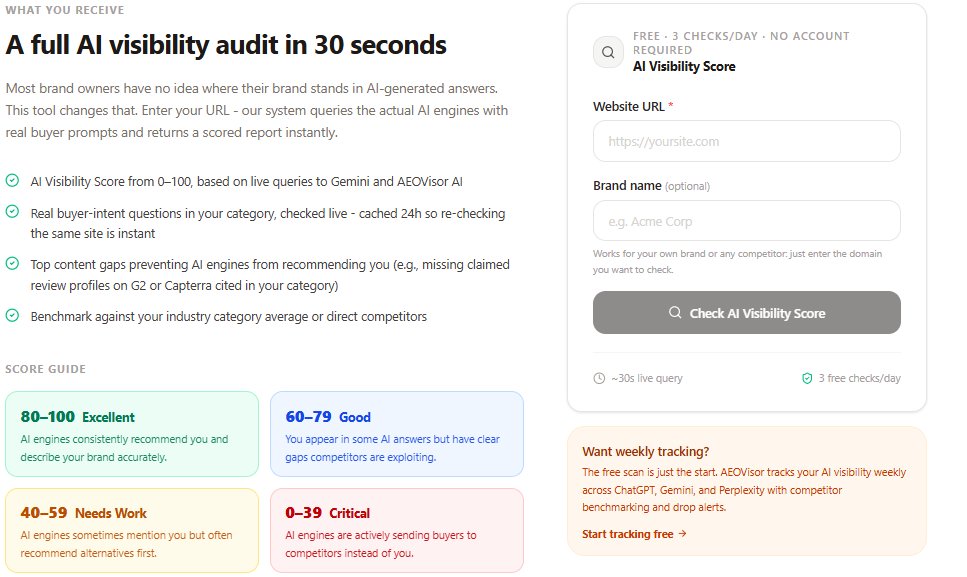
An AI Visibility Score rolls your overall performance across engines into one benchmarked number, usually on a 0 to 100 scale. It gives you a metric you can actually report to leadership. AEOVisor's Free AI Visibility Score distills performance across ChatGPT, Gemini, Perplexity, Claude, DeepSeek, and its own engine into a single score you can track week over week and compare against up to three competitors.
Citation Share
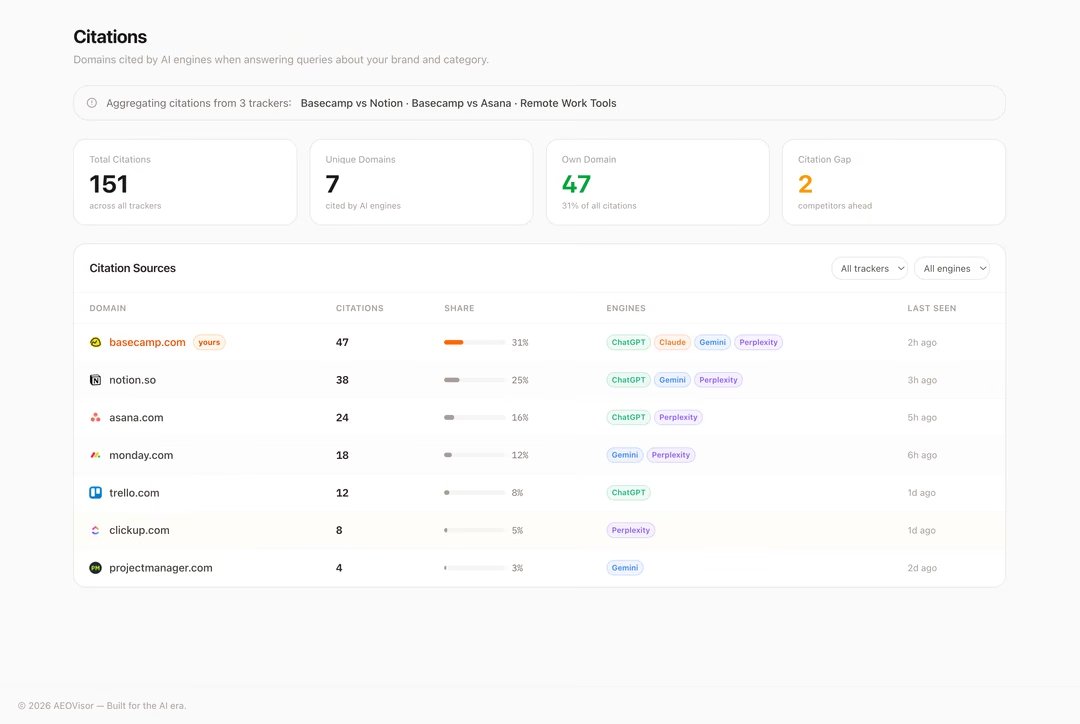
Citation share tracks how often AI engines pull from your website as a source, plus which other domains they favor. This is your roadmap for content and outreach. If Reddit threads and G2 reviews get cited more than your own pages, you know where to focus next.
Mention Frequency
Mention frequency counts how often your brand comes up across all tracked prompts, even without a direct citation. It is a fast read on brand awareness inside the models. Rising frequency usually means your recent content and PR efforts are landing.
Average Position
Average position shows where your brand tends to appear in an answer. Being named first carries more weight than being buried at the bottom of a list. A strong average position means the AI treats you as a top pick, not an afterthought.
Sentiment
Sentiment measures the tone the AI uses when it talks about your brand. Positive, neutral, or negative framing shapes buyer perception at scale. If engines say your product has a steep learning curve, that is a signal to publish better tutorials and onboarding docs.
How AI Brand Monitoring Actually Works
AI brand monitoring works by sending a set of real buyer prompts to each answer engine on a schedule, capturing the responses, and analyzing them for your brand and your competitors. The tool then scores the results, tracks changes over time, and flags shifts in mentions or sentiment. It is prompt testing at scale, run automatically so you do not have to copy and paste queries all day.
The process breaks down into a few clear stages, and understanding them helps you trust the numbers.
It starts with prompts. You define the questions your buyers actually ask, such as "best CRM for startups" or "alternatives to [competitor]." These become the queries the tool runs.
Next comes execution. The platform sends each prompt to ChatGPT, Gemini, Perplexity, Claude, and other engines, then records every answer. Running this weekly (or daily on higher tiers) captures the drift we talked about earlier.
Then comes analysis. The tool parses each response to check whether your brand appears, where it appears, how it is described, and which sources the engine cited. That raw data becomes your Share of Voice, citation share, sentiment, and the rest.
AEOVisor's AI Brand Monitor handles this loop with automated weekly scans, Share of Voice trends, tone and sentiment alerts, and coverage across ChatGPT, Gemini, Perplexity, Claude, and DeepSeek. Its Citation Intelligence layer reverse-engineers the exact pages engines read before recommending a brand, so you can see the Reddit threads, review sites, and blogs shaping the answer. Setup takes minutes, no code or API keys required.
How to Set Up AI Brand Mention Tracking Step by Step
To set up AI brand mention tracking, build a prompt list, add your brand and competitors, run the prompts across multiple engines on a schedule, then review the results and act on the gaps. The whole thing takes about five minutes to configure and starts returning data within days. Here is the practical walkthrough.
Step 1: Build your prompt list
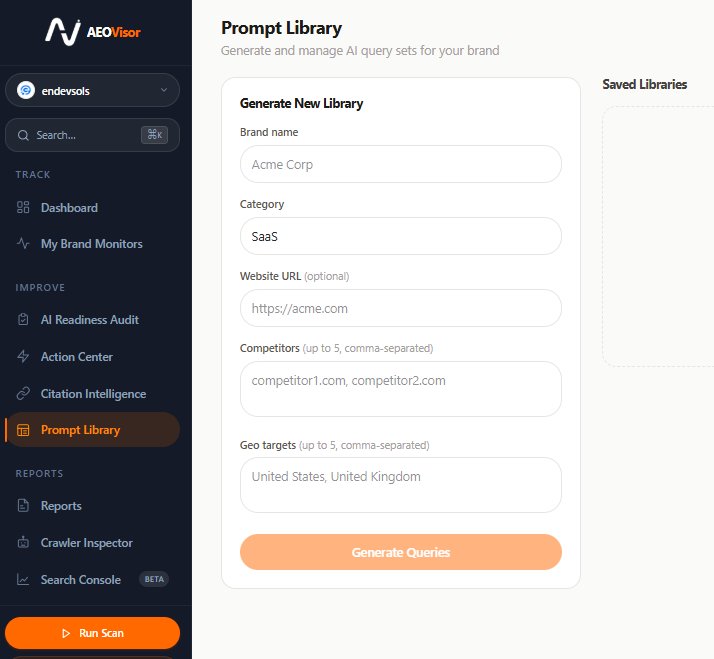
Start with the questions buyers ask when they are evaluating tools in your category. Think beyond keywords, because AI prompts are longer and more conversational than search queries. A great trick: ask your sales and customer success teams which questions prospects raise, and add a "how did you find us?" field to your contact form to capture real AI prompts.
Step 2: Add your brand and your competitors
List your brand name plus any aliases or spellings people use, then add your main competitors. Comparing yourself against rivals is where the insight lives. Without competitors in the mix, you only see half the picture.
Step 3: Run prompts across every engine
Do not settle for one platform. Run your prompts through ChatGPT, Gemini, Perplexity, Claude, and DeepSeek, because each pulls from different sources and can rank you differently. Schedule the scans to repeat weekly so you catch changes as models update.
Step 4: Establish your baseline
Your first run is your starting line. Note your Share of Voice, AI Visibility Score, average position, and citation share. You cannot measure progress without this snapshot, so resist the urge to change everything before you have a baseline.
Step 5: Review, prioritize, and act
Once data rolls in, look for the biggest gaps: prompts where competitors win, engines where you are invisible, or pages getting cited instead of yours. AEOVisor's Action Center ranks fixes by their estimated visibility impact, so your team always knows the highest-leverage move to make next. Tackle one or two items, then watch the next scan to confirm the change.
Which Prompts to Track and How to Read the Results
Track the prompts that map to real buyer intent: category questions, "best tool for X" queries, comparison prompts, and problem-based questions your product solves. Then read the results by comparing your metrics against competitors and looking for the specific prompts and engines where you fall short. The goal is not more data, it is clear next steps.
Pick prompts across the buyer journey. Early-stage prompts like "how do I solve [problem]" reveal whether the AI even knows you exist. Mid-funnel prompts like "best [category] tools" show competitive standing. Bottom-funnel prompts like "[your brand] vs [competitor]" reveal how AI frames you head to head. A healthy prompt set covers all three.
When you read the results, focus on the deltas. A low Share of Voice on a high-value prompt is a clear opportunity. A page from a review site outranking yours in citation share tells you to either improve your own content or pursue a mention on that site. Negative sentiment on a specific theme points straight at a content or product story you need to fix.
Then close the loop with action. There are two levers: improve your owned content so engines cite you directly, and pursue off-page mentions on the sites engines already trust. If you want a deeper grounding in the strategy behind this, our guide on answer engine optimization walks through how to structure content so AI models pick it up. And Citation Intelligence shows you exactly which pages to target first.
Frequently Asked Questions
Is it possible to track brand mentions in AI search?
Yes, it is absolutely possible to track brand mentions in AI search. You do it by running buyer prompts through answer engines like ChatGPT and Perplexity on a repeating schedule and analyzing the responses for your brand. Dedicated tools automate this so you get consistent, trended data instead of one-off manual checks.
How is tracking AI mentions different from traditional SEO?
Tracking AI mentions measures whether models name and recommend your brand in generated answers, while traditional SEO measures where your pages rank in a list of blue links. AI answers change per prompt and per engine, so the metrics shift from keyword position to Share of Voice, citation share, and sentiment. Both matter, but they need different tools. Our breakdown of AEO vs SEO explains how the two fit together.
What is an AI Visibility Score?
An AI Visibility Score is a single benchmarked number, typically 0 to 100, that summarizes how visible your brand is across multiple answer engines. It combines signals like mention frequency and position into one metric you can report and track over time. It is useful because it turns messy, per-prompt data into a clear trend line for stakeholders.
How can a SaaS company measure visibility in ChatGPT?
A SaaS company measures visibility in ChatGPT by defining a set of relevant buyer prompts, running them through ChatGPT on a schedule, and checking how often the brand is mentioned, where it appears, and how it is described. Tracking the same prompts weekly reveals whether visibility is climbing or slipping. An AI brand monitoring tool handles the scans and scoring automatically across ChatGPT and other engines.
How often should I track brand mentions in AI search?
Track brand mentions in AI search at least weekly, because AI answers drift as models update and competitors publish new content. Weekly scans catch shifts early enough to react, while monthly checks often miss important changes. Higher-frequency daily tracking helps during active campaigns or right after a product launch.
Ready to see how AI engines talk about your brand? Set up your first brand tracker with AEOVisor's AI Brand Monitor and get your Share of Voice score across ChatGPT, Gemini, Perplexity, Claude, and DeepSeek within days.